

Asset Management System Supporting Foundation
Mastering Asset Management Decisions

All ISO 55001-conforming Asset Management Systems (AMS) are enabled by a robust, deliberate supporting foundation. This foundation makes effective Asset Management (AM) Framework decision-making possible.
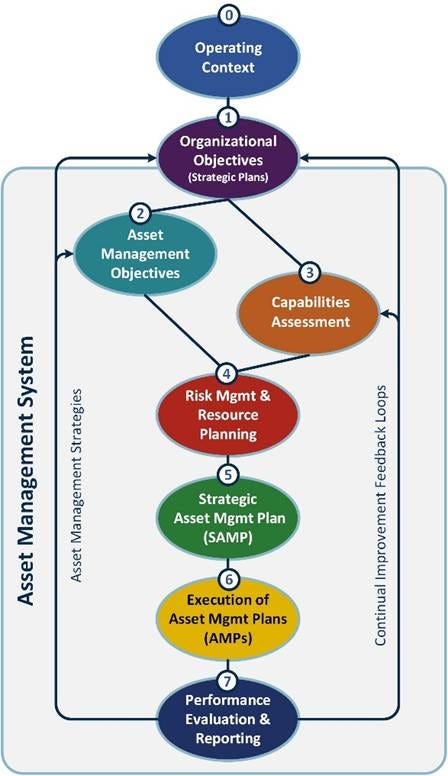
ISO 55001 requires that disciplined asset management be implemented through a decision-making framework, such as shown above. Per ISO 55001:2024, clause 4.5.1, this framework is used to:
define and determine the value that the organization aims to derive from its assets by applying the asset management system;
define the criteria to be used for asset management decision-making to achieve the determined value.
This does not happen on its own. It requires a robust AMS built on a strong support foundation. Following directly from the comprehensive overview in article #167 of the core AMS Behaviors (Context, Leadership, Planning/Strategy, Risk Management, Operations, Performance Evaluation, Continual Improvement, Policy, Objectives, Processes, IT Enablement, and Outcomes), this article focuses on the elements of support. These seven interconnected elements—detailed across AMP Newsletter articles #67 through #73—are the often-underappreciated foundation that makes every AMS behavior effective
It All Starts with a Solid Foundation
Without strong supporting foundation, even the best-designed asset management plans, leadership commitment, and operational execution cannot deliver consistent, risk-informed investment decisions. This foundation ensures the organization has the right people, knowledge, data, documentation, and communication channels to evaluate trade-offs, manage uncertainty, allocate resources wisely, and achieve measurable results. In short, supporting foundation elements are what transform good intentions into reliable, high-performing actions.
This is where the central doctrine of the entire AMP Newsletter comes alive in practice:
Better Asset Management Leads to Better Outcomes
Robust support is not bureaucratic overhead. Support elements are the enablers that allow organizations to move from reactive facility management to proactive, value-driven decisions that improve financial performance, reduce risk, enhance operational readiness, and deliver sustained mission success for facility assets and the built environment.
Each support element aligns directly with the requirements in ISO 55001:2024, Clause 7 Support (7.1–7.7). The 2024 edition strengthened and clarified these requirements (including new dedicated subclauses for data/information and knowledge) to reflect real-world needs in complex asset portfolios. Here is a synopsis of each article in the miniseries, with its connection to the broader themes of disciplined facility asset management, the AM Framework, and superior outcomes:
#67 AMS Behavior: Support (1/7) – Resources (ISO 55001 7.1)
This opening article examines how organizations must determine and provide the full range of resources—human, financial, technological, infrastructural, and external—needed to establish, implement, maintain, and continually improve the AMS. It stresses that under-resourcing (a common failure mode in facility portfolios) directly compromises the ability to conduct proper risk assessments, develop credible asset management plans (AMPs), and execute investment decisions. Adequate resources are the prerequisite for turning the AM Framework’s risk-informed decision-making into reality.
#68 AMS Behavior: Support (2/7) – Competence (ISO 55001 7.2)
Competence goes far beyond basic training. This article details how to determine the specific competencies required for roles that affect asset performance, asset management performance, and AMS performance; ensure people possess them through education, training, or experience; evaluate effectiveness; and periodically reassess. In facility asset management, this means having personnel who can perform lifecycle cost analysis, mission dependency indexing, risk modeling, and optimization—not just maintenance tasks. Competent people are essential for high-quality risk-informed decisions that lead to better outcomes.
#69 AMS Behavior: Support (3/7) – Awareness (ISO 55001 7.3)
Awareness ensures that everyone whose work can impact asset management objectives understands the policy, their personal contribution and responsibilities, the benefits of improved performance, the consequences of nonconformity, and how their daily activities relate to risks and opportunities. This article highlights practical ways to build and measure awareness across the organization. When people at all levels “get it,” they make better day-to-day choices that support strategic objectives—directly feeding the “Better Asset Management Leads to Better Outcomes” cycle.
#70 AMS Behavior: Support (4/7) – Communication (ISO 55001 7.4)
Effective communication and stakeholder engagement are not optional. This article covers determining what, when, with whom, and how to communicate internally and externally about assets, asset management, and the AMS. It emphasizes consulting stakeholders when designing communication approaches and evaluating effectiveness. Clear, timely communication prevents misalignment between financial and operational functions, reduces misunderstandings in investment prioritization, and builds the trust needed for sustained support of long-term facility strategies.
#71 AMS Behavior: Support (5/7) – Documented Information (ISO 55001 7.5)
This article addresses the requirements for creating, updating, and controlling documented information (including what must be documented, how to maintain it, and how to handle external documents). It explains how documented information provides the backbone for consistency, traceability, and auditability. In practice, well-managed documented information supports repeatable decision-making, preserves institutional knowledge, and enables performance evaluation and continual improvement—key to reliable risk-informed investment decisions.
#72 AMS Behavior: Support (6/7) – Data and Information (ISO 55001 7.6)
A 2024 enhancement, this dedicated subclause focuses on determining needed data and information, establishing specifications (attributes, quality, source), planning for collection/integration/quality/sharing, and aligning financial and non-financial information. The article explores practical challenges in facility asset data (condition, utilization, mission dependency, costs, etc.) and how poor data quality undermines even the best analytics and optimization models. High-quality, accessible data and information are non-negotiable for credible risk assessment and evidence-based investment decisions that deliver better outcomes.
#73 AMS Behavior: Support (7/7) – Knowledge (ISO 55001 7.7)
The final support article covers determining the knowledge needed to operate the AMS and putting processes in place to utilize, retain, acquire, make accessible at decision time, and handle outdated knowledge. It addresses how organizations must consider current knowledge when facing changing requirements and trends. In facility asset management, this includes capturing lessons from past investments, lifecycle experiences, and risk events. Effective knowledge management prevents repeated mistakes and accelerates organizational learning—directly supporting smarter, lower-regret decisions and the long-term realization of value from assets.
Putting It All Together
These seven support elements do not operate in isolation. They are deeply interconnected and form the enabling layer beneath the entire AMS. When they are strong, the AM Framework (MAGs), risk-informed resource and investment decision-making, and performance evaluation all function at a higher level. When they are weak, even excellent leadership and planning produce suboptimal or inconsistent results.
This is why the AMP Newsletter consistently returns to the principle that Better Asset Management Leads to Better Outcomes. The support elements are where that principle becomes operational reality for facility assets and built infrastructure. They give organizations the capability to make defensible, risk-informed investment decisions that balance short-term needs with long-term value, reduce the “price of regret,” and demonstrably improve organizational performance, resilience, and sustainability.
In upcoming articles, we will continue building on this foundations with deeper dives into implementation, activation, culture, and emerging topics such as AI enablement. If this overview of the support elements helps clarify how to strengthen your organization’s AMS, please like, share, and subscribe.
Full access to the complete AMS Behavior miniseries, templates, and playbooks is available to subscribers.
Better Asset Management Leads to Better Outcomes
Written by: Jack Dempsey | June 16, 2026 | AMP Newsletter #169
Copyright © 2026, Asset Management Partnership LLC. All Rights Reserved.